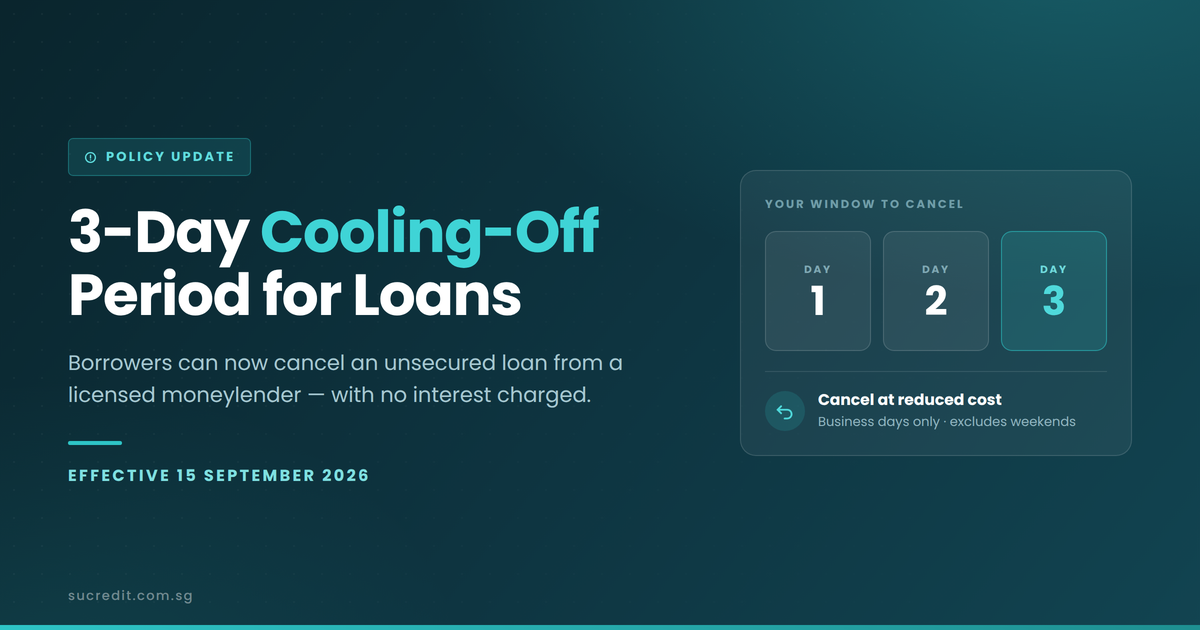



Borrowers in Singapore now have a second chance to reconsider an unsecured loan. From 15 September 2026, every unsecured loan taken from a licensed moneylender comes with a mandatory three-business-day cooling-off period, during which the borrower can walk away from the loan at a sharply reduced cost. The framework was announced by the Ministry of Law (MinLaw) on 31 August 2026 and developed in consultation with the Credit Association of Singapore, the professional body representing licensed moneylenders. Business loans are the one exception — the cooling-off period applies to all other unsecured loans from licensed moneylenders. Timing How the Three Days Are Counted Only business days count. Saturdays, Sundays and Singapore public holidays are excluded, so a loan disbursed on a Friday afternoon leaves the borrower with a window that runs through the following Wednesday rather than expiring over the weekend. The Cost of Cancelling What Changes If You Cancel This is the part that matters most in practical terms. Under the previous position, a moneylender could keep the entire loan approval fee plus any interest that had accrued, even if the borrower changed their mind almost immediately. Cancelling was therefore an expensive decision. From 15 September 2026, a borrower who cancels within the cooling-off period pays no interest at all, and the lender may keep only a capped slice of the loan approval fee. Loan of $5,000 or below $50 The most the lender may retain — and never more than the approval fee actually charged. Loan above $5,000 3.5% Of the loan principal — and never more than the approval fee actually charged. Maximum portion of the loan approval fee a licensed moneylender may retain on cancellation. Business loans are excluded from the cooling-off framework. Two safeguards sit on top of those caps. The lender can never retain more than the approval fee it originally charged, and the total amount you repay can never exceed the principal amount of the loan. Worked Example A $1,000 loan with a 10% approval fee Cancelled inside the cooling-off window Principal $1,000 · approval fee 10% · cancelled on day 2 Amount that reaches the borrower after the $100 approval fee is deducted upfront $900.00 Approval fee the lender may retain capped at $50 because the principal is $5,000 or below $50.00 Interest charged no interest applies to a loan cancelled in the window $0.00 Total Repayable $950.00 The same arithmetic applies to larger loans, with the 3.5% cap replacing the flat $50 figure. The Reasoning Why the Fee Isn’t Refunded in Full MinLaw has framed the retained portion as compensation for real work already done: the overhead and due diligence a licensed moneylender carries out before approving a loan. The intent is to give borrowers genuine room to reconsider a decision that may have been made under pressure, while keeping licensed lending commercially viable — a balance MinLaw says it will continue to maintain between protecting borrowers and preserving reasonable access to credit from licensed sources. The 15 September start date was itself chosen to give licensed moneylenders time to adjust their processes and systems. The Registry of Moneylenders, which sits under MinLaw, will continue working with the industry on implementation. Industry Guidance Better Practices the Industry Is Being Encouraged to Adopt Separately, in April 2026 the Registry of Moneylenders updated its Professional Service Handbook for Licensed Moneylenders, encouraging lenders to adopt three borrower-friendly practices: Reward good repayment behaviour — discounts or rebates on interest and/or fees for on-time repayments, or for loans settled ahead of schedule. Offer digital touchpoints — tools such as an online portal where borrowers can track their own loan servicing. Help borrowers in difficulty early — restructuring repayment into something that fits the borrower’s actual financial situation, and/or referring them to a Social Service Agency for support. These are recommended practices rather than legal requirements, but they are a useful yardstick when comparing lenders. Before You Borrow Confirm the Lender Is Licensed The cooling-off period exists only in the licensed sector. An unlicensed lender offers none of these protections. ✓ Check the Registry A licensed moneylender operates under the Moneylenders Act and is listed on the Registry of Moneylenders. ✓ Expect a face-to-face meeting A licensed lender must meet you in person at its approved place of business to verify your identity before granting a loan. ✓ Ignore loan offers by message Licensed moneylenders are not permitted to solicit loans by SMS, WhatsApp, phone call or social media. A licensed moneylender operates under the Moneylenders Act, is listed on the Registry of Moneylenders, and must meet you in person at its approved place of business to verify your identity face-to-face before granting a loan. Source: Ministry of Law, “Mandatory Cooling-off Period for Loans Taken from Licensed Moneylenders”, 31 August 2026 — read the original release . This article is a plain-English summary for general information and is not legal advice. SU Credit Pte Ltd is a licensed moneylender in Singapore.