

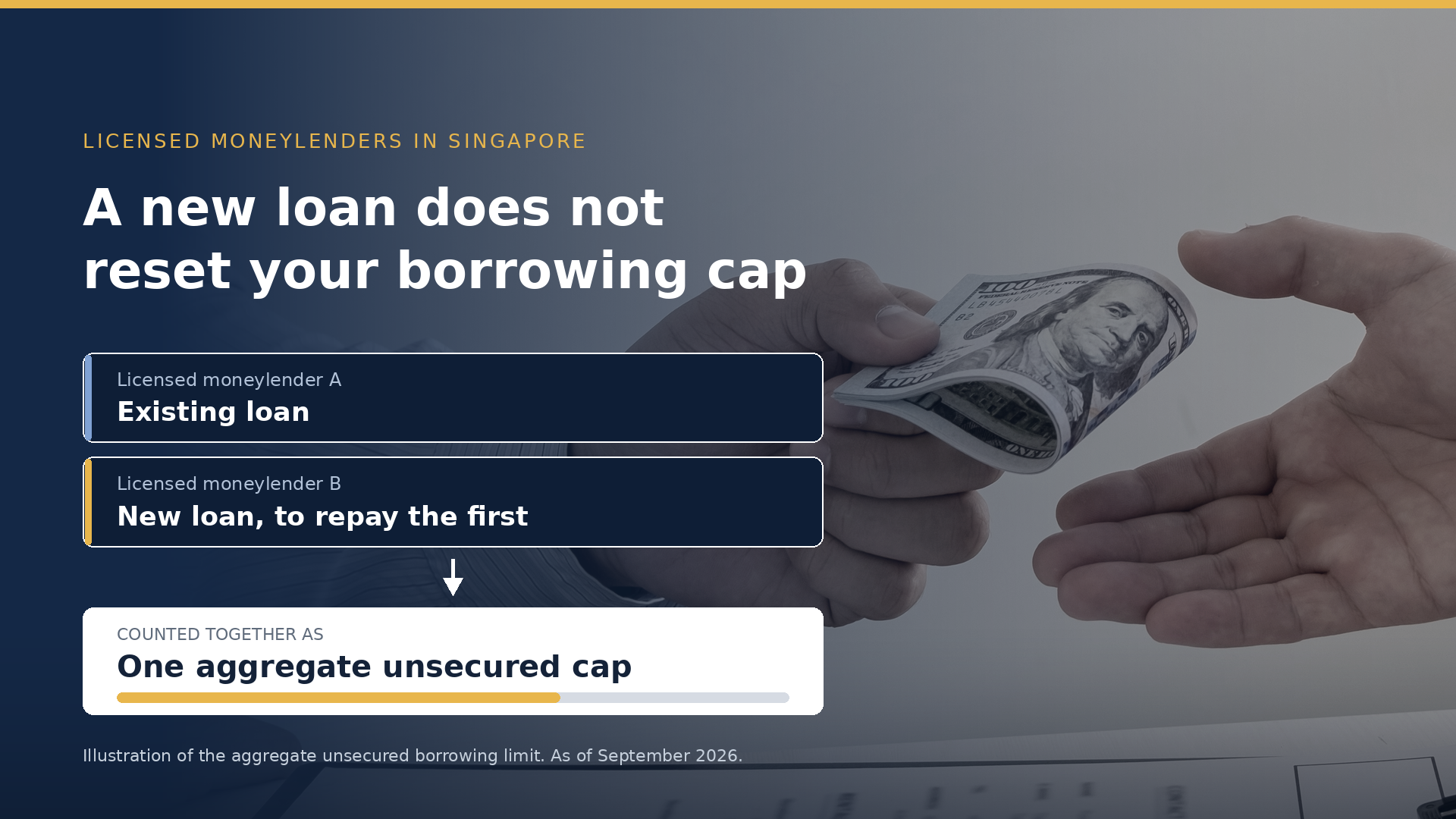
Yes. There is no blanket prohibition in Singapore on using a loan from a licensed moneylender to repay another licensed moneylender’s loan — the debt consolidation scheme is built around that purpose. What a new loan does not do is give you a fresh borrowing limit. And as of September 2026, the Registrar’s Directions specifically tell licensees not to use a re-loan from the same lender to reset your borrowing cost. Here is how the limits, the cost, and the rules work.
Can you take a new moneylender loan to pay off an existing loan?
Yes, subject to the borrowing limits. Licensed moneylenders in Singapore can lend you money that you then use to repay an existing loan, and the Ministry of Law’s debt consolidation scheme is defined around exactly that purpose. What does not change is the ceiling: everything you owe across all licensed moneylenders counts towards one aggregate cap. Approval is subject to the lender’s assessment of your income, existing loans, and repayment ability.
Is it legal in Singapore to borrow from one licensed moneylender to repay another?
Yes, and the regulatory framework contemplates it. The Registry of Moneylenders’ Professional Service Handbook for Licensed Moneylenders (Version 3.1, dated 13 August 2026) defines a debt consolidation loan as “a loan granted by a licensed moneylender under the debt consolidation scheme to a borrower for the purpose of enabling the borrower to repay all outstanding debts owed by the borrower to all licensed moneylenders”.
There is no blanket ban. What still applies are the aggregate borrowing limits, the lender’s assessment, the rules on excluded persons, and the restriction on same-lender re-loans set out next.
Can the same moneylender give you a new loan to clear the one you already owe them?
Not where it resets your borrowing cost. Registrar’s Directions No. 1 of 2026, effective 1 April 2026, state that licensees “should not grant loans or ‘re-loans’ to borrowers to reduce or extinguish an existing debt owed to the same licensee such that this serves to ‘reset’ the total borrowing cost charged, as this is tantamount to deliberately circumventing rules 11, 12 and 12A of the Moneylenders Rules 2009”.
Paragraph 1.3 of the same Directions lists as an undesirable practice “offering loans or ‘re-loans’ to pay off existing loans when borrowers are unable to fully pay sums that are due, and charging the borrowers a 10% ‘administrative fee’ repeatedly to roll over the existing loan”.
Genuine loan restructuring that complies with the Moneylenders Rules 2009 is still permitted. But the Directions state that these practices may be grounds for refusing a licence renewal, or for suspending or revoking a licence.
If a lender offers to clear your existing loan with them by writing a new one that starts the cost over, that is the arrangement the Directions target. Ask about restructuring instead.
How much can you borrow if you already have outstanding moneylender loans?
As of September 2026, the unsecured borrowing cap for licensed moneylender loans in Singapore is an aggregate figure — it applies to everything you owe across all licensed moneylenders combined, not to each lender separately. A Singapore Citizen or PR earning below S$20,000 a year can borrow up to S$3,000 in total. At S$20,000 or more, the cap is six times monthly income. Existing outstanding unsecured principal counts towards it.
Unsecured borrowing caps, aggregate across all licensed moneylenders (as of September 2026)
| Annual income | Singapore Citizens and PRs | Foreigners residing in Singapore |
| Below S$10,000 | S$3,000 | S$500 |
| S$10,000 to below S$20,000 | S$3,000 | S$3,000 |
| S$20,000 or more | 6 × monthly income | 6 × monthly income |
For secured loans, the Registry of Moneylenders states you can obtain a loan of any amount. Your existing loans are visible through the Moneylenders Credit Bureau (MLCB), operated by Credit Bureau (Singapore) Pte Ltd as the designated credit bureau, which a licensed moneylender checks when assessing an application. Source: Registry of Moneylenders, FAQs on Borrowing From Licensed Moneylenders.
If I’ve joined the MLCB self-exclusion scheme, can I still take a loan to repay my existing one?
Generally no, with one exception. Self-exclusion is a voluntary scheme through the MLCB. Singapore Citizens and PRs may choose a minimum period of 1 or 2 years; foreigners have a minimum of 2 years. While you are registered, you generally cannot obtain unsecured loans from licensed moneylenders, except for a debt consolidation loan.
What would a new loan to repay an old one actually cost you?
As of September 2026, licensed moneylenders in Singapore may charge at most 4% interest per month on the outstanding principal, and at most 10% of the principal as an administrative fee when the loan is granted. Late interest is capped at 4% per month on the overdue amount, plus a fee of at most S$60 for each month of late repayment. These are legal maximums, not the rate any lender quotes.
One further limit matters here: total charges — interest, late interest, the administrative fee and late fees combined — cannot exceed the principal.
How is 4% monthly interest worked out on a balance that shrinks as I repay?
Interest is charged on what is still outstanding, so it falls as the principal comes down. Illustration only, using the legal maximum rate on an S$3,000 loan repaid in six monthly principal instalments of S$500:
- Month 1: S$3,000 outstanding, interest S$120
- Month 2: S$2,500 outstanding, interest S$100
- Month 3: S$2,000 outstanding, interest S$80
- Month 4: S$1,500 outstanding, interest S$60
- Month 5: S$1,000 outstanding, interest S$40
- Month 6: S$500 outstanding, interest S$20
Total interest: S$420. Add an administrative fee of up to 10% of the principal at grant (S$300), and borrowing S$3,000 costs up to S$720. This is an illustration calculated from the statutory maximums — not a SuCredit product or quotation.
Do I pay the administrative fee again on the new loan?
As of September 2026, a licensed moneylender in Singapore may charge an administrative fee of up to 10% of the principal when a loan is granted, so a new loan can carry a new fee — up to S$300 again on the illustration above. This is also the charge the 2026 Directions single out when the same lender rolls the same debt over. Work the fee out before you decide, because it is paid upfront out of money you have not yet used.
When does replacing one loan with another make sense, and when does it make things worse?
It can make sense when the new loan reduces what you will pay in total, or turns several repayment dates into one you can meet. It makes things worse when the instalment falls only because the tenure has been stretched. On the same S$3,000 at the same maximum rate, repaying over 12 months instead of six drops the monthly principal to S$250 — but total interest rises from S$420 to S$780, before any fresh administrative fee.
Compare five things, not one: the outstanding principal, the fee on the new loan, the interest over the new tenure, the revised repayment schedule, and the total remaining cost of each option. A lower monthly figure on its own tells you nothing about which loan is cheaper.
If your income has not changed and the new loan only buys time, the routes below are the better place to start.
What are the alternatives to taking a second loan to repay the first?
Three routes are worth trying first. Ask your existing lender about restructuring, which the 2026 Directions allow where it complies with the Moneylenders Rules. Go to Credit Counselling Singapore, which runs the Moneylender Debt Management Programme to arrange repayment of unsecured debts owed to licensed moneylender creditors within a maximum of two years — 6225 5227, 51 Cuppage Road #07-06, Singapore 229469. Or register for MLCB self-exclusion to stop the cycle from extending.
The Registry of Moneylenders does not restructure loans itself. Its Professional Service Handbook (Version 3.1, August 2026) lists seven social service agencies that help debt-distressed borrowers: Adullam Life Counselling (6659 7844), Association of Muslim Professionals (6416 3960), Arise2Care Community Services (6909 0628), Blessed Grace Social Services (8428 6377), Credit Counselling Singapore (6225 5227), One Hope Centre (6547 1011) and Silver Lining Community Services (6749 0400). General money management guidance is published by MoneySense, the national financial education programme.
How do you check a lender is licensed before you borrow?
Check the Ministry of Law’s list of licensed moneylenders in Singapore, published by the Registry of Moneylenders — the current edition is dated 1 September 2026. Match the business name, licence number, address and telephone number against the entry. A licensed moneylender in Singapore also may not retain your NRIC or any other identity document, or ask for your SingPass user ID or password.
To report a moneylender, contact the Registry of Moneylenders on 1800-2255-529. For suspected unlicensed moneylending, call the police X-Ah-Long hotline on 1800-924-5664.
If a lender messages me by SMS or WhatsApp offering to clear my existing loan, is that a licensed moneylender?
Treat it as a warning sign, but not as proof either way. Under the Registrar’s Directions on Advertising & Marketing Activities of Licensed Moneylenders (Version 3.0, effective 1 April 2025), licensees may advertise only through directories in print or online media, their own websites, and materials within or on the exterior of the approved place of business. All other advertising and marketing activities are not permitted. An unsolicited SMS or WhatsApp offer falls outside every permitted channel, so it may come from an unlicensed moneylender or from a licensed one in breach. Do not reply; check the Registry’s list instead.
Before you borrow again: weigh your income against what you already owe, borrow only what you need and can repay, and work through the alternatives above first. A loan that lowers your monthly payment by extending the tenure usually raises what you pay overall.
Frequently asked questions
Is there a limit on the total interest and fees I can be charged, or only on the monthly rate?
Both. As of September 2026, licensed moneylenders in Singapore may charge at most 4% interest per month, and total charges on a loan cannot exceed the principal. The permitted charges are the S$60 monthly late fee, the 10% administrative fee at grant, and legal costs ordered by a court for a successful recovery claim.
Can a licensed moneylender refinance or top up my existing loan with them?
As of September 2026, Registrar’s Directions No. 1 of 2026 tell licensees not to grant a loan or re-loan that reduces or extinguishes a debt owed to the same licensee where this resets the total borrowing cost. Genuine restructuring that complies with the Moneylenders Rules 2009 remains possible. Approval is subject to the lender’s assessment.
What proof will I have that my old loan is fully settled?
Licensed moneylenders in Singapore must issue a receipt every time you make a repayment, give you a copy of the Note of Contract with the terms explained to you, and provide a statement of account for your loans at least once every January and July. The Registry advises borrowers to retain all statements and receipts as evidence of payment.
What can I do if a moneylender charges above the legal caps, keeps my NRIC, or asks for my SingPass login?
Licensed moneylenders in Singapore may not retain your NRIC or other identity documents, ask for your SingPass user ID or password, or charge above the legal caps — as of September 2026, 4% interest per month and an administrative fee of at most 10% of principal. Report such conduct to the Registry of Moneylenders on 1800-2255-529.
Does a licensed moneylender loan affect my chances of getting a bank loan later?
Loans from licensed moneylenders in Singapore are recorded with the Moneylenders Credit Bureau (MLCB), operated by Credit Bureau (Singapore) Pte Ltd as the designated credit bureau. Licensed moneylenders request borrower information from that bureau when assessing applications, and the Moneylenders Act restricts how it may be used and disclosed. Bank lending decisions run on separate credit records.
What happens if I cannot repay the new loan either?
As of September 2026, a licensed moneylender in Singapore may charge late interest of at most 4% per month on the overdue amount, plus a fee of at most S$60 for each month of late repayment, and total charges still cannot exceed the principal. The Registry states that lenders may take reasonable steps to recover debts, including asking for repayment and taking legal action. Debt collectors cannot resort to vandalism, violence, or threatening words or behaviour; if that happens, lodge a police report.