
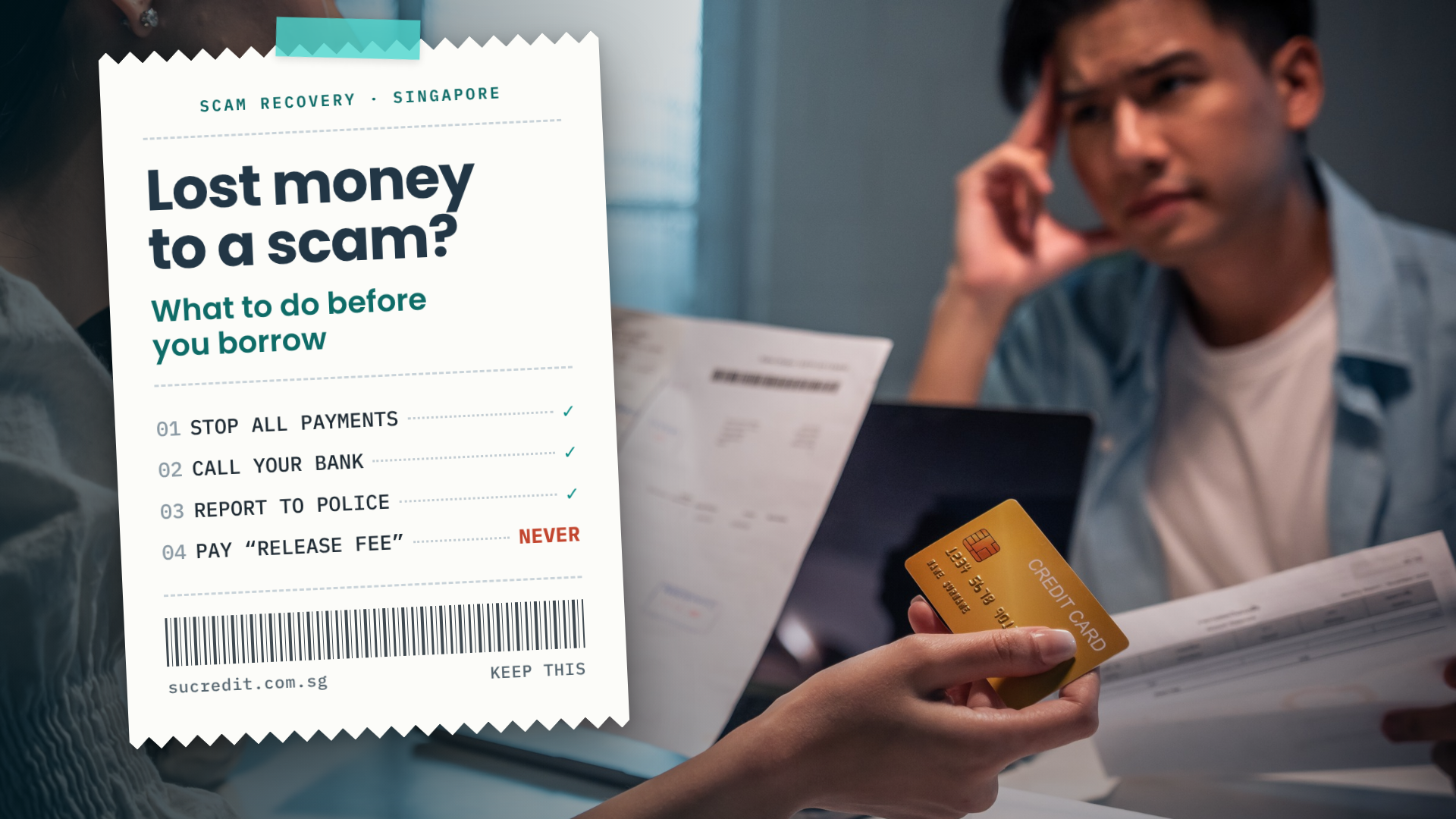
When money has just gone to a scammer, the urgent job can feel like replacing it. It isn’t. The jobs that can’t wait are free: stop any more money leaving, get your bank to secure your accounts, and report the scam to the Police. Whether a loan has any part in this can wait until you know what’s recoverable and what you owe, and no loan should ever go towards a fee that someone says will release or recover your money.
In the days after a scam, you’ll hear plenty of things that aren’t true, some of them from the scammers. After the first-hour steps below are seven beliefs worth checking, each with what actually happens.
The first hour
- Stop sending money, whatever you’re being told and however urgent it sounds.
- Call your bank’s fraud hotline to secure or freeze the affected accounts and cancel any card that’s been compromised. Take the number from the bank’s official website, not from a message. Some banks also have a “kill switch” that lets you freeze your own account; what it blocks differs from bank to bank.
- Report it to the Police, online or at a Neighbourhood Police Centre or Neighbourhood Police Post. Include when and how it happened, the scammer’s contact details, screenshots, receipts, transaction records and any reference numbers you’ve been given. For urgent help, dial 999. The Police Hotline, 1800-255-0000, is for passing on crime-related information, not emergencies.
- Lock down what you shared. Change any passwords you gave away, watch your accounts, and tell the providers involved. If it was your Singpass, call the Singpass Helpdesk on +65 6335 3533 and press 9 to suspend the account. Self-suspension works around the clock, though the helpdesk’s staff are there only Monday to Friday, 9am9 am 6p6 pmexcept public holidays.
Speed matters because scammers can move money through several accounts quickly, including accounts overseas.
Calling 1799 reports the scam
It doesn’t. The ScamShield Helpline (1799, or +65 6869 1799 from overseas) runs 24/7 and is a good first call if you’re not sure what’s happened: it can help you assess a suspected scam, give advice and connect you to participating banks. But it can’t file a police report for you, and it can’t give you updates on an investigation or a frozen bank account later.
The police report is its own step. Once it’s in, ScamShield says you should get an acknowledgement letter or email within seven working days. From then on, the Investigation Officer (IO) handling your case is your contact, and updates you when there’s a significant development.
The bank will give the money back.
Maybe, but don’t count on it. Whether anything comes back depends on how the scam worked and where the money went. Once it’s been transferred overseas, recovery may be very difficult, because the Police can’t directly use Singapore’s legal powers over foreign accounts. How long an investigation takes, and when any seized money is returned, varies from case to case.
You may have read about the Shared Responsibility Framework (SRF), introduced by MAS and IMDA. It applies to a defined scope of phishing scams. It isn’t compensation for every scam, and it doesn’t generally cover transfers you made yourself, such as money sent to a fake investment platform. A claim depends on the framework’s scope, whether the parties met their duties under it, and your circumstances.
If you think your bank should pay, complain to the bank first. If it says no, the Financial Industry Disputes Resolution Centre (FIDReC) may take the dispute on, through mediation and, where appropriate, adjudication, provided the bank subscribes to it and the dispute is eligible. You generally have six months from the bank’s final reply to approach FIDReC. Filing is free; adjudication carries a fee, and the limit is S$150,000 per claim for claims filed from 1 July 2024. FIDReC deals with disputes against financial institutions. It doesn’t chase scammers, and an eligible claim can still fail.
Can someone recover it for a fee?
Don’t pay anyone who says they can. The Police warned about fund-recovery scams in February 2024 and issued another advisory in August 2026. In the 2024 advisory, scammers posed as law firms or financial-services companies and asked for upfront payments, banking credentials, or remote-access software on the victim’s device. If a law firm is named, look it up yourself in the Legal Services Regulatory Authority (LSRA) directory rather than calling a number they give you.
An investment platform that says your profits are ready once you pay a fee, a deposit, or a tax is asking for the same thing in different words. That request is a reason to stop and check independently, not a reason to find the money.
A real lender might ask for GST before paying out.
That’s the scam talking. The Registry of Moneylenders, the Ministry of Law’s regulator for licensed moneylenders, warns that demands for “GST” or a “processing fee” before a loan is paid out are a scam. A licensed moneylender may deduct a loan-approval fee of up to 10% of the principal when the loan is granted, and must still pay you the correct principal after that deduction. A deduction at that point is a different thing from a transfer you’re asked to make first.
The way the offer reaches you is another clue. Under the Registrar’s Advertising and Marketing Directions (Version 3.0, in force since 1 April 2025), licensed moneylenders can advertise only in business or consumer directories, on their own websites, and at or on their approved business premises. Promotion by SMS, WhatsApp, WeChat, or emails to the public, patrons or former patrons isn’t allowed. Messages to existing customers about a loan they already have are treated separately.
Licensed moneylender or fake lender: what to look for (rules checked October 2026)
| A licensed moneylender | A fake lender | |
|---|---|---|
| On the official list | Yes, with the same business name, address, licence number, phone number, and website it gives you. | No, or it borrows a licensed lender’s name, website or social-media page |
| How it reaches you | Directories, its own website and its approved premises | Unsolicited SMS, WhatsApp, WeChat, phone calls or social-media posts |
| Money before the loan | A loan-approval fee of up to 10% of the principal may be deducted when the loan is granted; the correct principal must still be paid out. | Asks you to transfer a separate “GST”, “processing” or “release” fee before you receive anything |
| Your Singpass and ID | Mustn’t ask for your Singpass user ID or password, or keep your NRIC, passport, driving licence, work permit, employment pass or ATM card | Asks for your Singpass details or other credentials |
| Before you sign | Checks your identity in person at its approved premises; gives you a copy of the Note of Contract and explains the terms in a language you understand | Sends official-looking documents instead |
If licensed moneylenders turn you down, an unlicensed one isn’t a way round it. Carrying on a moneylending business without a licence is generally prohibited under section 5 of the Moneylenders Act 2008. If you come across one, tell the Police on 1800-255-0000 or through police.gov.sg/iwitness.
Being scammed cancels the loans I took
Not by itself. If you signed for a loan with a licensed moneylender, even to send money to the scammer, the Registry of Moneylenders says borrowers are legally obliged to fulfil loan contracts with licensed moneylenders. The sooner each lender hears from you, the better, and ideally that’s before an instalment is due that you can’t meet.
Get the paperwork together first. A licensed moneylender must give you a copy of the Note of Contract when the loan is granted, a receipt for every repayment, and a statement of account at least once every January and July. You can also get your own loan information report from the Moneylenders Credit Bureau (MLCB), on its website or in person. If a payment does slip, our guide for borrowers changing jobs or leaving Singapore works through what late payments add.
A loan you never applied for is different.
Tell the lender straight away, make a police report, and keep the application and transaction evidence. Check your MLCB report for anything else you don’t recognise. If a licensed moneylender may have acted improperly, contact the Registry of Moneylenders. Whether you’re liable for a loan someone else took out in your name depends on the facts, so get advice before you hand over any money for it. FIDReC only comes into it if the dispute is with a financial institution that subscribes to it and falls within its rules.
A loan will put this right.
It can’t, though it may help with something narrower. A loan can make sense for a cost that won’t wait, such as rent, once every payment to the scammer has stopped, and you can repay it from income you can count on. It makes no sense as a way to pay a release fee, a recovery charge,e or anyone’s “tax”, and it shouldn’t depend on a refund you’re still hoping for.
Loans from the scam period matter here as well. There’s a legal cap on how much you can owe licensed moneylenders in unsecured loans, and it covers all of them together, so what you borrowed then counts towards it. The Registry’s borrower FAQ gives the cap for each income band. Any lender, us included, will look at what you earn, what you already owe, and whether you can keep up repayments before deciding whether to lend at all, and how much.
Talk to a debt counsellor before a lender. Credit Counselling Singapore (6225 5227) counsels people on debt for free; a non-refundable fee of S$50 to S$250 applies only if it submits a Debt Management Programme proposal to your creditors for you. It can help with what you owe, but it can’t recover money lost to scammers.
There’s nothing the family can do
There is, though it has limits. If a parent or relative keeps sending money and won’t listen, contact their bank about safeguards, transaction controls and account-security features. Some participating banks offer MoneyLock. Features differ between banks, and being family doesn’t let you take over someone else’s account.
The Police have a stronger tool. Under the Protection from Scams Act 2025, in force since 1 July 2025, they can issue a restriction order that restricts specified banking transactions and the grant or use of credit facilities, for up to 30 days at first, with up to five extensions of up to 30 days each. Family and friends still matter while an order is in place, both for support and for help with the practical arrangements.
I have to deal with this on my own
You don’t. If you’d like emotional support during the investigation or a court case, tell your Investigation Officer, who can arrange for you to speak to a Victim Care Officer: a volunteer trained to give emotional and practical support to people going through the criminal justice process.
If you’ve kept it to yourself so far, think about telling one person you trust. The calls, the statements, a nd any decision about money can be easier with someone beside you.
Words you’ll hear in the next few weeks
- Investigation Officer (IO): the police officer handling your report, who updates you when there’s a significant development.
- Victim Care Officer: a trained volunteer your IO can arrange to speak with.
- Kill switch: a feature at some banks that lets you freeze your own account. What it blocks varies by bank.
- Shared Responsibility Framework (SRF): MAS and IMDA’s framework for a defined scope of phishing scams. Not a general refund scheme.
- FIDReC: the Financial Industry Disputes Resolution Centre, for eligible disputes with the financial institutions that subscribe to it, once you’ve complained to the institution.
- Restriction order: a Police order under the Protection from Scams Act 2025 that limits specified banking transactions and credit for a set period.
- Note of Contract: your loan contract with a licensed moneylender. You should get a copy when the loan is granted.
- MLCB report: your own loan information report from the Moneylenders Credit Bureau.
- LSRA directory: the Legal Services Regulatory Authority’s directory, where you can check a law firm that’s been named to you.
If the pull to borrow is really a wish to undo what happened, give it a few days. A loan can cover rent. It can’t make the loss smaller.
Before you deal with any moneylender, us included, check it against the licensed moneylenders list that the Ministry of Law publishes. SU Credit appears there under Licence No. 114/2026.
SU CREDIT PTE. LTD. Licensed by the Ministry of Law’s Registrar of Moneylenders (Licence No. 114/2026) 175 Bencoolen Street, #01-36, Burlington Square, Singapore 189649 · Tel: 6636 5644
Got a question about a loan you have with us? Call us or come by the office.
Sources
- ScamShield: I’ve been scammed, ScamShield Helpline and What happens after I lodge a police report for scam-related cases?
- MoneySense: I suspect I’ve been scammed! What should I do? (updated 28 September 2026)
- Singapore Police Force: Advisory on fund recovery services scams (29 February 2024) and the fund-recovery scam advisory of 27 August 2026
- Singpass: singpass.gov.sg (Helpdesk and account suspension)
- Monetary Authority of Singapore: Shared Responsibility Framework, mas.gov.sg
- Financial Industry Disputes Resolution Centre: fidrec.com.sg
- Legal Services Regulatory Authority: directory of law practices
- Registrar of Moneylenders: Advertising and Marketing Directions, Version 3.0 (effective 1 April 2025)
- Registry of Moneylenders, Ministry of Law: FAQs on Borrowing From Licensed Moneylenders and List of Licensed Moneylenders in Singapore (list as at 1 November 2026)
- Singapore Statutes Online: Moneylenders Act 2008 and Protection from Scams Act 2025, sso.agc.gov.sg
- Moneylenders Credit Bureau: mlcb.com.sg
- Credit Counselling Singapore: ccs.org.sg