
How much can you borrow from a licensed moneylender? Most people expect the answer to depend on which lender they walk into, the way a credit limit depends on which card you hold. In Singapore, it works differently. The ceiling is set by law; it follows you from lender to lender, and every licensed moneylender in the country works from the same figure.
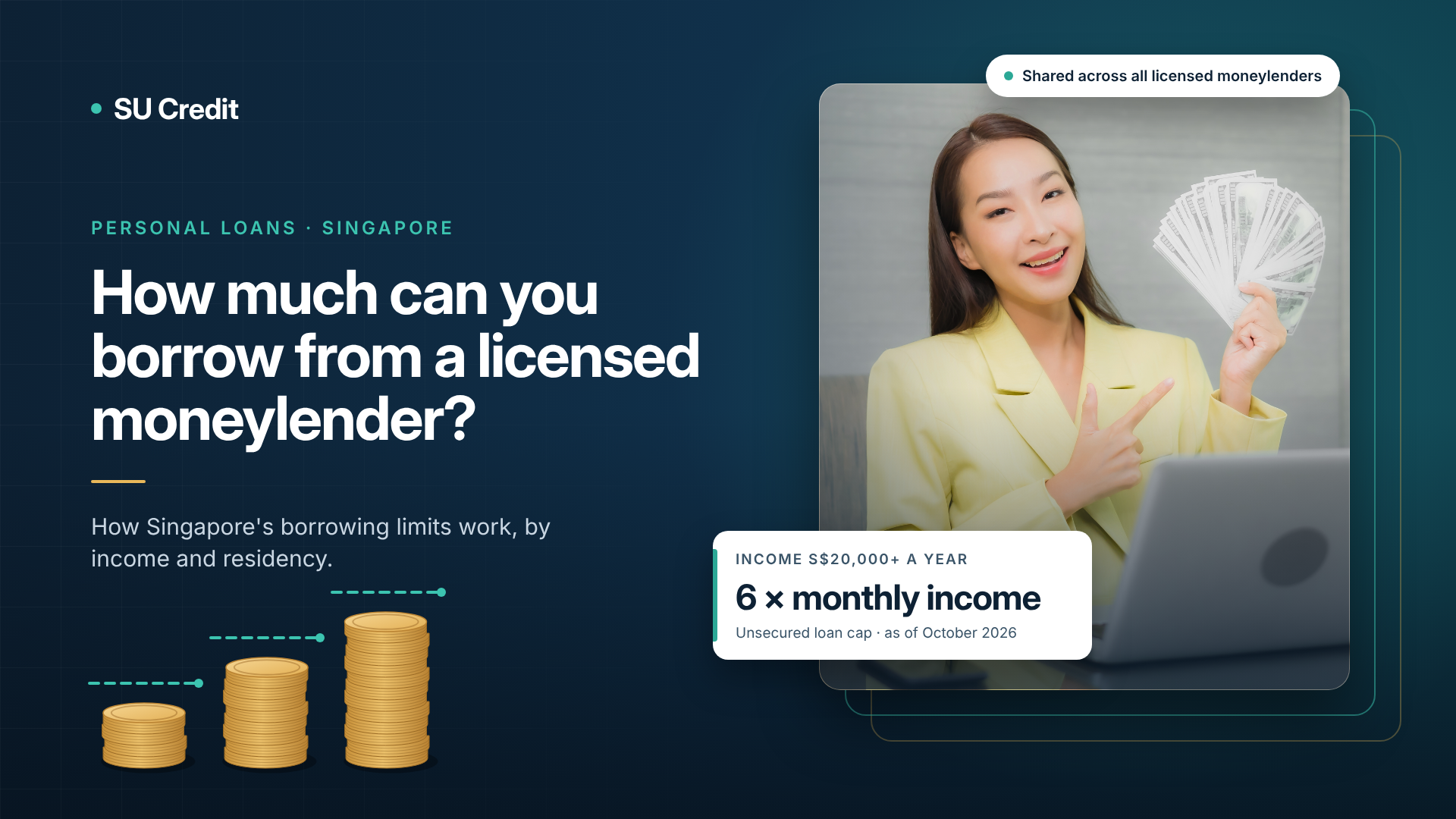
For unsecured loans, that figure is S$3,000 if you earn less than S$20,000 a year, and six times your monthly income if you earn S$20,000 or more. Foreigners living in Singapore who earn under S$10,000 a year have a lower ceiling of S$500. What a lender actually offers you can be less.
The limit in one table
The most you may borrow in unsecured loans from all licensed moneylenders combined (November 2026)
| Your annual income | Singapore Citizens and PRs | Foreigners residing in Singapore |
|---|---|---|
| Less than S$10,000 | S$3,000 | S$500 |
| S$10,000 to under S$20,000 | S$3,000 | S$3,000 |
| S$20,000 or more | 6 × monthly income | 6 × monthly income |
Source: Registry of Moneylenders, Ministry of Law.
Two details in that table are easy to miss. One is the jump at S$20,000. The other is the word “combined”.
What happens at the S$20,000 line
Below S$20,000 a year, the limit is a flat amount. Whether you earn S$12,000 or S$19,000, the ceiling is the same S$3,000.
At S$20,000, the rule switches from a flat amount to a multiple of your pay, and the ceiling jumps. Take someone who is paid the same amount every month and earns exactly S$20,000 a year. That is about S$1,667 a month, and six times S$1,667 is S$10,000. So the limit doesn’t climb gradually from S$3,000. It more than triples at the line, and from there it rises in step with income:
- S$2,500 a month: up to S$15,000
- S$3,500 a month: up to S$21,000
- S$5,000 a month: up to S$30,000
What counts as “monthly income” is less tidy. The Registry’s FAQ gives the multiple but doesn’t explain how the monthly figure is worked out when pay is uneven. If yours moves around, because you earn commission, drive for a platform or run your own business, ask the lender how it will arrive at the figure before you count on a number.
Is the limit per lender, or across all of them?
Across all of them. The Registry describes the figures in the table as “the total maximum amount that you may borrow at any time across all moneylenders in Singapore”. Borrow S$2,000 from one lender, and that S$2,000 counts against your limit at every other lender too.
The Moneylenders Credit Bureau (MLCB) is what makes this enforceable. The Ministry of Law announced it in 2016 to tighten control over the total unsecured credit one person could take from licensed moneylenders. Every licensed moneylender sends the bureau regular updates on its borrowers’ loans, and checks your record there when you apply.
According to the Ministry, the report lists all your active loans with licensed moneylenders: the type and length of each loan, the principal still outstanding, the total amount payable and whether your repayments are up to date. There is little point in leaving a loan off the application form. The lender can see it in the report.
You can see it too. Borrowers can buy their own report; when the MLCB was announced, the price was S$1. Check the current fee and how to apply at mlcb.com.sg.
The Registry’s wording is “across all moneylenders”, so this ceiling concerns loans from licensed moneylenders. Bank loans and credit cards are recorded separately, though they can still affect what a lender is willing to offer.
Work out your own number.
It takes three steps.
- Find your row in the table. Under S$20,000 a year, the ceiling is the flat amount shown. At S$20,000 or more, multiply your monthly income by six.
- Add up what you still owe on unsecured loans from licensed moneylenders. Your statements of account show the principal outstanding on each loan (a licensed moneylender must send you one at least every January and July), and so does your own MLCB report.
- Subtract. What remains is the most that could still be open to you under the law, before any lender has assessed you.
Treat the result as an outer edge. Paying down part of a loan doesn’t automatically entitle you to borrow that amount again, and it’s worth asking the lender how it counts your existing loans.
Here is how that plays out for four made-up borrowers. Each is paid the same amount every month, and all four earn more than S$10,000 a year, so the figures are the same for Citizens, PRs and foreigners living in Singapore.
Four illustrations (invented figures, limits as at November 2026)
| Monthly income | Annual income | Legal ceiling | Still owed to licensed moneylenders | Most that could be left |
|---|---|---|---|---|
| S$1,600 | S$19,200 | S$3,000 | Nothing | S$3,000 |
| S$1,700 | S$20,400 | S$10,200 | Nothing | S$10,200 |
| S$3,500 | S$42,000 | S$21,000 | S$6,000 with one lender | S$15,000 |
| S$4,000 | S$48,000 | S$24,000 | S$16,000 with one lender, S$8,000 with another | Nothing |
The first two rows are S$100 a month apart in pay and S$7,200 apart in their ceilings. That is the S$20,000 line at work. The last row is the one people don’t expect: a S$4,000 salary, with no room at all, because two existing loans already reach the ceiling.
Why a lender may offer less than the ceiling
The ceiling binds the lender. Inside it, the lender decides. The Registry says it is “primarily the business decision of the licensed moneylender” whether to grant a loan and how much. Approval is subject to the lender’s assessment of your income, existing loans, and repayment ability.
That assessment runs on paperwork. One of the Registry’s warning signs is a lender that approves a loan before it has received your application form and supporting documents such as “the income tax assessment and payslips”. Turn that around, and you have a fair picture of a proper application: it starts with documents. Our own personal loan page asks for your NRIC, your last three months’ payslips, income tax statements, CPF statements, and a bill showing your home address.
So if the ceiling for your income is S$21,000 and you’re offered S$8,000, nothing has gone wrong. The lender has looked at what you earn, what you already owe, and how you’ve repaid, and settled on what it is prepared to lend. You’re free to compare. The Registry itself suggests that borrowers “shop around different moneylenders for the most favourable terms” and not commit until they’re satisfied with them.
Be more careful with the opposite case: someone offering your full ceiling without asking to see anything.
What the limit leaves out
Secured loans. “For secured loans, you can obtain a loan of any amount,” the Registry says. No income-based ceiling applies, but the security brings a risk of its own. The Registry asks borrowers to think carefully before agreeing to any term that lets a moneylender lodge a caveat on the sale proceeds of their property. With a caveat in place, you can’t sell without first repaying the moneylender in full, and that repayment “can wipe out all or a substantial portion of the proceeds”. There is more on the difference in our explainer on secured and unsecured loans.
Business loans and debt consolidation loans. The Registry’s borrower FAQ doesn’t say how these count against the limit, so ask the lender before you apply.
Cost. The limit caps the amount; separate caps govern the price. Interest can be at most 4% a month on the principal you still owe, depending on your income and whether or not the loan is secured. Late interest is at most 4% a month on the late amount, the late fee at most S$60 for each month of late repayment, and the upfront fee at most 10% of the principal. Together, these charges “cannot exceed an amount equivalent to the principal of the loan”; court-ordered legal costs are separate. Our guide to changing jobs or leaving Singapore with a loan works through what missed instalments add.
If you’re already at the limit
Once your existing loans reach the ceiling, the law doesn’t allow a licensed moneylender to take your unsecured borrowing past it. Anyone offering to do so is either breaking the rules or isn’t licensed. Complaints about a licensed moneylender go to the Registry on 1800-2255-529. Suspected unlicensed moneylending goes to the Police on 1800-255-0000, or online at police.gov.sg/iwitness.
Reaching the limit is usually a reason to look at the debt you already have before looking for more credit. The Registry’s first piece of advice to anyone thinking of approaching a moneylender is to consider the alternatives, including financial assistance schemes run by government agencies.
If the repayments themselves are the problem, speak to your lender early. The Registry can’t restructure a loan for you, because it treats that as a private matter between you and the lender. It does list seven voluntary welfare organisations that help people with moneylender debts:
- Adullam Life Counselling: 9423 8832
- Association of Muslim Professionals (AMP): 6416 3960
- Arise2Care Community Services: 6909 0628
- Blessed Grace Social Services: 8428 6377
- Credit Counselling Singapore: 6225 5227
- One Hope Centre: 6547 1011
- Silver Lining Community Services: 6749 0400
If you’re weighing up a fresh loan to clear an old one, read our piece on taking a new moneylender loan to pay off an existing loan first.
Some people would sooner close the door for a while. Apply to the MLCB for self-exclusion, and licensed moneylenders can’t grant you any unsecured loan apart from a debt consolidation loan. Citizens and PRs choose a minimum of one or two years; for foreigners, it is two. After that, the exclusion stays in place until you withdraw it. Nobody can be excluded without their own consent, so a relative can’t arrange it for you.
A ceiling isn’t a target.
Everything above is about what the law permits. What you can repay is a different sum, and you’re the one who has to do it: the instalments need to fit alongside rent, food, transport and whatever else is fixed each month. The Registry’s advice on this is one line long: “Borrow only what you need and can repay.”
If you’ve already signed for more than you needed, unsecured loans other than business loans, paid out on or after 15 September 2026, come with a three-business-day cooling-off period.
SU CREDIT PTE. LTD. Licensed by the Ministry of Law’s Registrar of Moneylenders (Licence No. 114/2026) 175 Bencoolen Street, #01-36, Burlington Square, Singapore 189649 · Tel: 6636 5644
You can check our licence, or any moneylender’s, on the Ministry of Law’s list of licensed moneylenders. If you’d like to go through how the limit applies to your income and existing loans, call us or visit the office with your documents.
Sources
- Registry of Moneylenders, Ministry of Law: FAQs on Borrowing From Licensed Moneylenders (last updated 6 November 2026)
- Registry of Moneylenders, Ministry of Law: List of Licensed Moneylenders in Singapore
- Ministry of Law: New Credit Bureau to Support Prudence in Borrowing and Lending (press release, 24 February 2016)
- Moneylenders Credit Bureau