


Home » Blog New
Skip to main content

Welcome to Sucredit

Home » Blog New

Blog New

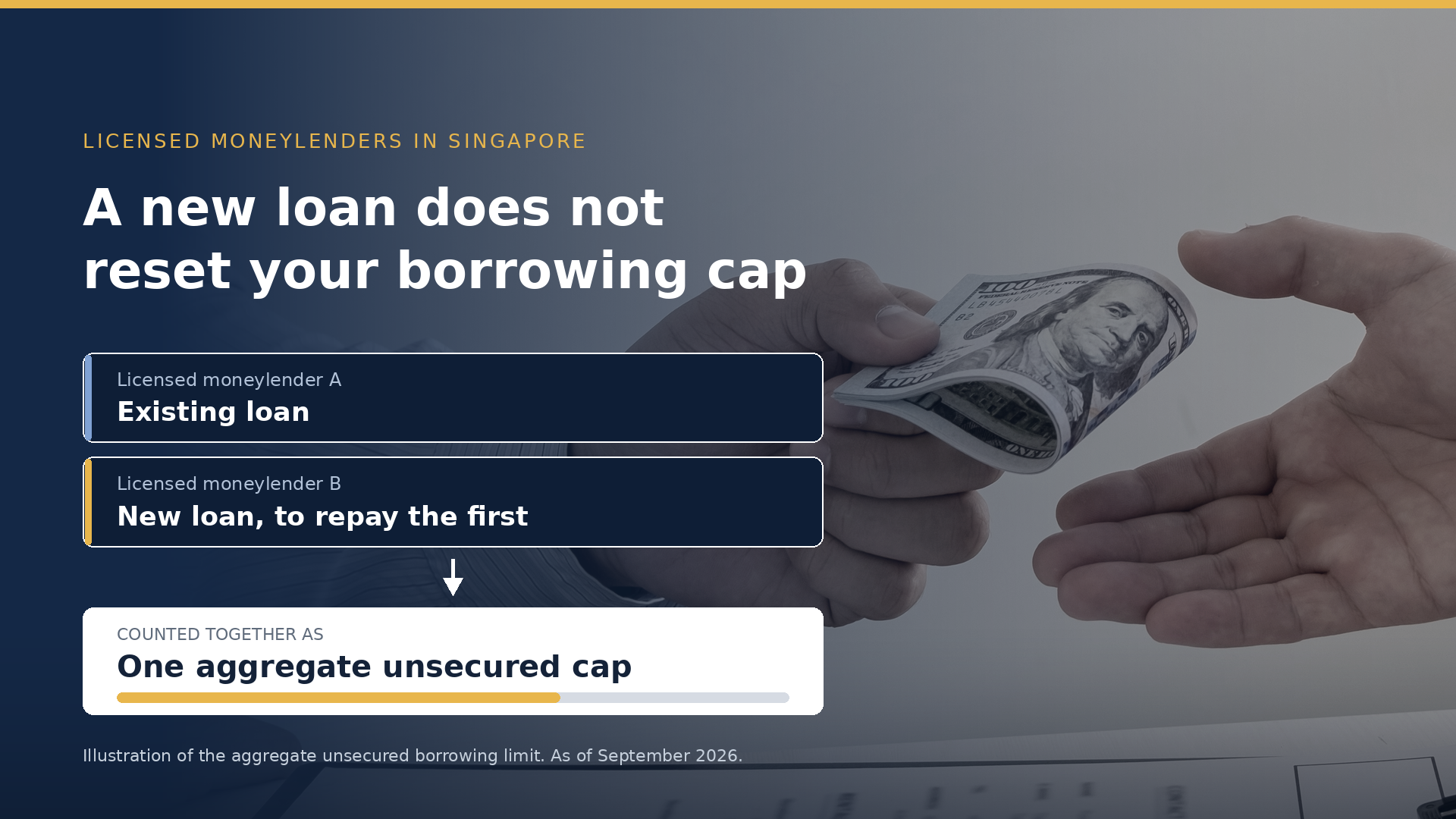
Hero banner showing a borrowing-themed scene: hands exchanging money with the headline 'A new loan does not reset your borrowing cap' and two loan option panels below.
debt consolidation

Can You Take a New Moneylender Loan to Pay Off an Existing Loan?

Yes. There is no blanket prohibition in Singapore on using a loan from a licensed moneylender to repay another licensed moneylender’s loan — the debt consolidation scheme is built around that purpose. What a new loan does not do is give you a fresh borrowing limit. And as of September 2026, the Registrar’s Directions specifically tell licensees not to use a re-loan from the same lender to reset your borrowing cost. Here is how the limits, the cost, and the rules work. Can you take a new moneylender loan to pay off an existing loan? Yes, subject to the borrowing limits. Licensed moneylenders in Singapore can lend you money that you then use to repay an existing loan, and the Ministry of Law’s debt consolidation scheme is defined around exactly that purpose. What does not change is the ceiling: everything you owe across all licensed moneylenders counts towards one aggregate cap. Approval is subject to the lender’s assessment of your income, existing loans, and repayment ability. Is it legal in Singapore to borrow from one licensed moneylender to repay another? Yes, and the regulatory framework contemplates it. The Registry of Moneylenders’ Professional Service Handbook for Licensed Moneylenders (Version 3.1, dated 13 August 2026) defines a debt consolidation loan as “a loan granted by a licensed moneylender under the debt consolidation scheme to a borrower for the purpose of enabling the borrower to repay all outstanding debts owed by the borrower to all licensed moneylenders”. There is no blanket ban. What still applies are the aggregate borrowing limits, the lender’s assessment, the rules on excluded persons, and the restriction on same-lender re-loans set out next. Can the same moneylender give you a new loan to clear the one you already owe them? Not where it resets your borrowing cost. Registrar’s Directions No. 1 of 2026, effective 1 April 2026, state that licensees “should not grant loans or ‘re-loans’ to borrowers to reduce or extinguish an existing debt owed to the same licensee such that this serves to ‘reset’ the total borrowing cost charged, as this is tantamount to deliberately circumventing rules 11, 12 and 12A of the Moneylenders Rules 2009”. Paragraph 1.3 of the same Directions lists as an undesirable practice “offering loans or ‘re-loans’ to pay off existing loans when borrowers are unable to fully pay sums that are due, and charging the borrowers a 10% ‘administrative fee’ repeatedly to roll over the existing loan”. Genuine loan restructuring that complies with the Moneylenders Rules 2009 is still permitted. But the Directions state that these practices may be grounds for refusing a licence renewal, or for suspending or revoking a licence. If a lender offers to clear your existing loan with them by writing a new one that starts the cost over, that is the arrangement the Directions target. Ask about restructuring instead. How much can you borrow if you already have outstanding moneylender loans? As of September 2026, the unsecured borrowing cap for licensed moneylender loans in Singapore is an aggregate figure — it applies to everything you owe across all licensed moneylenders combined, not to each lender separately. A Singapore Citizen or PR earning below S$20,000 a year can borrow up to S$3,000 in total. At S$20,000 or more, the cap is six times monthly income. Existing outstanding unsecured principal counts towards it. Unsecured borrowing caps, aggregate across all licensed moneylenders (as of September 2026) Annual income Singapore Citizens and PRs Foreigners residing in Singapore Below S$10,000 S$3,000 S$500 S$10,000 to below S$20,000 S$3,000 S$3,000 S$20,000 or more 6 × monthly income 6 × monthly income For secured loans, the Registry of Moneylenders states you can obtain a loan of any amount. Your existing loans are visible through the Moneylenders Credit Bureau (MLCB), operated by Credit Bureau (Singapore) Pte Ltd as the designated credit bureau, which a licensed moneylender checks when assessing an application. Source: Registry of Moneylenders, FAQs on Borrowing From Licensed Moneylenders. If I’ve joined the MLCB self-exclusion scheme, can I still take a loan to repay my existing one? Generally no, with one exception. Self-exclusion is a voluntary scheme through the MLCB. Singapore Citizens and PRs may choose a minimum period of 1 or 2 years; foreigners have a minimum of 2 years. While you are registered, you generally cannot obtain unsecured loans from licensed moneylenders, except for a debt consolidation loan. What would a new loan to repay an old one actually cost you? As of September 2026, licensed moneylenders in Singapore may charge at most 4% interest per month on the outstanding principal, and at most 10% of the principal as an administrative fee when the loan is granted. Late interest is capped at 4% per month on the overdue amount, plus a fee of at most S$60 for each month of late repayment. These are legal maximums, not the rate any lender quotes. One further limit matters here: total charges — interest, late interest, the administrative fee and late fees combined — cannot exceed the principal. How is 4% monthly interest worked out on a balance that shrinks as I repay? Interest is charged on what is still outstanding, so it falls as the principal comes down. Illustration only, using the legal maximum rate on an S$3,000 loan repaid in six monthly principal instalments of S$500: Month 1: S$3,000 outstanding, interest S$120 Month 2: S$2,500 outstanding, interest S$100 Month 3: S$2,000 outstanding, interest S$80 Month 4: S$1,500 outstanding, interest S$60 Month 5: S$1,000 outstanding, interest S$40 Month 6: S$500 outstanding, interest S$20 Total interest: S$420. Add an administrative fee of up to 10% of the principal at grant (S$300), and borrowing S$3,000 costs up to S$720. This is an illustration calculated from the statutory maximums — not a SuCredit product or quotation. Do I pay the administrative fee again on the new loan? As of September 2026, a licensed moneylender in Singapore may charge an administrative fee of up to 10% of the principal when a loan is granted, so a new

Smiling woman outdoors holding a tablet, next to a dark teal panel with the headline: ‘Can a sole proprietor get a business loan in Singapore?’
business loan

Can a Sole Proprietor Get a Business Loan in SG? | SU Credit

Yes. A sole proprietor can borrow in Singapore, including from a licensed moneylender. What changes compared with a company is who the lender is lending to. When you trade as a sole proprietorship and borrow from a licensed moneylender, you borrow as an individual, and the limits and charges set under the Moneylenders Act apply to you personally rather than to your business name. That one fact shapes how much you can borrow, what it can cost, and who is responsible for repaying it. Can a sole proprietor get a business loan in Singapore? A sole proprietor can apply to a licensed moneylender in Singapore, and licensed moneylenders lend to sole proprietors as individual borrowers. Approval is subject to the lender’s assessment of your income, existing loans and repayment ability. Your unsecured borrowing limit is calculated from your personal annual income, and as of August 2026 that limit is capped under the Moneylenders Act. Licensed moneylenders in Singapore are licensed and regulated by the Registry of Moneylenders, Ministry of Law. A licensed moneylender is not a bank, and the caps, charge ceilings and borrower protections described on this page come from the Moneylenders Act and its Rules rather than from any individual lender’s policy. Who is the borrower when you run a sole proprietorship? Under the Moneylenders Act, a licensed moneylender lends to an individual borrower. If you trade as a sole proprietorship, that individual is you. The caps below therefore apply to you as a person, and across every licensed moneylender you have borrowed from, whatever trade name the money is used for. What do lenders actually look at when a sole proprietor applies? A licensed moneylender in Singapore assesses three things: your income, your existing loans, and your ability to repay. Approval is subject to that assessment. No licensed moneylender can lend you more than the statutory cap for your income tier, however strong the rest of your application looks. Income, as assessed Your income determines your unsecured cap. For a sole proprietor the figure that matters is your assessed personal income, not the total passing through your business account: the cap is set against income, not turnover. What you already owe Licensed moneylenders check applications against the Moneylenders Credit Bureau (MLCB). The unsecured cap is an aggregate figure across all licensed moneylenders combined, so loans you already hold elsewhere reduce what remains available to you. Your ability to repay The third element is whether the repayments fit what you earn. How any lender weighs this is a matter for its own assessment, and no outcome can be promised in advance. Is it harder to get a loan as a sole proprietor than as a Pte Ltd? The structure you trade under does not change the statutory position when you borrow from a licensed moneylender in Singapore: you borrow as an individual, and the caps and charge ceilings under the Moneylenders Act apply to you personally. The practical consequence for a sole proprietor is that the debt is yours, not your trade name’s. If the business slows, the repayment obligation stays with you. Should a sole proprietor take a business loan or a personal loan? For a sole proprietor borrowing from a licensed moneylender, the distinction is thinner than it sounds. A licensed moneylender lends to you as an individual, so the same caps under the Moneylenders Act apply whether you describe the purpose as business or personal. Using the money for your business does not raise your cap, and it does not change the charge ceilings set out below. Is a “business loan” from a licensed moneylender the same as a personal loan? In substance, for a sole proprietor, yes: the borrower is the individual either way. If a lender describes a product to you as a business loan, ask which caps and charges apply, then check them against the figures below. How much can a sole proprietor borrow in Singapore? As of August 2026, if you are a Singapore Citizen or Permanent Resident earning less than S$20,000 a year, licensed moneylenders can lend you at most S$3,000 in unsecured loans in total, across all licensed moneylenders combined. If you earn S$20,000 or more, the cap is six times your monthly income. Foreigners residing in Singapore face lower tiers. Secured loans have no cap. Borrower Annual income Maximum unsecured borrowing Singapore Citizen or PR Below S$20,000 S$3,000 Singapore Citizen or PR S$20,000 or more 6 times monthly income Foreigner residing in Singapore Below S$10,000 S$500 Foreigner residing in Singapore S$10,000 to below S$20,000 S$3,000 Foreigner residing in Singapore S$20,000 or more 6 times monthly income Any borrower, secured loans Any No cap Unsecured borrowing caps under the Moneylenders Act, aggregate across all licensed moneylenders. Figures as of August 2026, from the Registry of Moneylenders, Ministry of Law. If I already have loans with other licensed moneylenders, how much more can I borrow? The cap is a total, not a per-lender allowance. As of August 2026, the unsecured limit for your income tier applies across all licensed moneylenders combined, and applications are checked against the Moneylenders Credit Bureau (MLCB). If you are already at your cap, a further unsecured loan from another licensed moneylender is not available to you. What is the maximum a licensed moneylender can charge me on top of what I borrow? As of August 2026, a licensed moneylender in Singapore may charge at most 4% interest per month, computed on the principal remaining after repayments. Late interest is capped at 4% per month and applies only to the amount repaid late. The late fee is capped at S$60 for each month of late repayment, and the administrative fee at 10% of the principal, charged when the loan is granted. Interest, late interest, the administrative fee and late fees added together can never exceed the principal you borrowed. Court-ordered legal costs are the only other charge a licensed moneylender may impose. The 4% monthly ceiling has been in effect since 1 October 2015 and

Close-up of a person reviewing financial documents with a calculator, symbolizing the search for the best personal loan in Singapore.
best money lender

5 Best Personal Loan Provider in Singapore

Searching for the best personal loan in Singapore can feel overwhelming with so many options out there. But, finding the right loan should be straightforward. That’s why we’ve put together a list of the top five personal loan providers in Singapore. This guide aims to simplify your search, helping you choose the best personal loan that fits your needs. This way, you can make a smart choice quickly and get back to what matters most in your life. Whether you need to manage debt, fund a big purchase, or handle unexpected costs, discovering the best personal loan in Singapore is now easier than ever. However, before moving forward, first we will find out what factors to consider when choosing the best personal money lender in Singapore. How to Choose the Best Personal Loan Provider in Singapore When looking for a personal loan, it’s common knowledge to carefully check and compare the interest rates offered by different lenders. But what else should you be mindful of? Below, we’re going to thoroughly explore factors that you should keep in mind when opting for the money lender in Singapore: Purpose of the Loan It’s essential to have a clear purpose for your loan. Whether it’s paying off debts with high interest, handling unexpected medical bills, dealing with emergencies, or making home improvements, using the loan for a meaningful purpose can lead to better financial health. Interest Rates The interest rate is a critical factor. The Applied Rate (AR) might look attractive, but it doesn’t account for the decreasing loan principal over time. The Effective Interest Rate (EIR), on the other hand, gives a true picture of the loan’s cost, considering the reduction in the principal. Always compare EIRs for a real cost comparison. Fees and Charges Don’t just stop at interest rates. Other fees can add up. Annual fees, late payment fees, and charges for changing your loan’s tenure can significantly increase the cost of your loan. Always ask about these extra charges before deciding. Borrowing Limit Your loan amount is not just a random figure. Banks look at your income, your credit score, and your banking relationship to decide how much you can borrow. Make sure the loan amount you’re considering is something you truly need and can manage without straining your finances. Disbursement Speed Sometimes, you need money fast. Check how quickly a lender can process your loan and get the funds to you. This speed can be crucial in emergencies. Lender Reliability Trust is key. Opt for a lender with a solid reputation to avoid any future disputes or issues with repayments. A well-established bank is often a safer choice than a less known lender. Early Repayment Fees Planning to pay off your loan early? Watch out for early repayment fees. These fees can take away from the savings you hoped to achieve by settling your loan ahead of schedule. Impact on Credit Card Limit If you’re taking a loan from the same bank where you have a credit card, your credit limit might drop by the loan amount. This reduction is temporary and will ease as you pay back the loan. Credit Score Impact Every loan affects your credit score. Borrowing within your means and repaying on time can actually improve your credit rating. Always consider how a new loan fits into your overall credit management strategy. Affordability of Repayments Finally, think about your budget. Can you comfortably make the loan repayments without cutting too close to your essential expenses? It’s crucial to ensure that taking out a loan doesn’t put undue pressure on your daily finances. By paying close attention to these factors, you can select a personal loan that not only meets your immediate needs but also fits comfortably within your financial landscape, ensuring peace of mind and financial stability. 5 Best Personal Loan Provider in Singapore 1. HSBC Personal Loan The HSBC Personal Loan stands out for those needing a flexible repayment period. It offers terms from one to seven years. It boasts an attractive starting interest rate of 3.60% per annum (with an EIR of 6.50%) for individuals earning more than S$30,000 a year. What sets the HSBC loan apart is its lengthy repayment option. It allows borrowers to extend their payment period up to seven years, the longest available in the market. Moreover, eligible applicants won’t face any processing fees. Borrowers can request loan amounts starting from S$1,000 up to a maximum limit of 95% (for HSBC Premier customers) or 90% of their available credit limit on their HSBC Personal Line of Credit. To apply, Singaporeans and Permanent Residents need a minimum yearly income of S$30,000. For foreigners living in Singapore, the required minimum annual income is S$40,000. HSBC’s personal loan is highly accessible, especially for expatriates. It has the lowest income requirement in the market for expatriates. The loan’s flexibility and generous cap make it ideal for those needing a larger loan over a more extended period, without the burden of heavy monthly repayments. With quick, 1-minute in-principle approval and no processing fees, HSBC offers an efficient and cost-effective loan solution. Expatriates will find the HSBC Personal Loan especially appealing, given its low minimum income requirement of S$40,000, compared to higher thresholds at other banks. 2. CIMB CashLite Personal Loan For those in Singapore seeking a personal loan with competitive rates, the CIMB CashLite Personal Loan emerges as a top choice, particularly for newcomers to CIMB. This loan shines with its low interest rates starting from 3.5% per annum. Beyond its attractive interest rates, the loan features zero processing fees and promises fast cash disbursement. Borrowers can request amounts starting from S$1,000, going up to 90% of their CIMB credit limit, or 70% if they’re tapping into a promotional offer. However, it’s important to note that this loan is not available to supplementary cardholders or non-residents. The loan’s flexibility is a significant advantage, offering repayment periods ranging from one to five years. The highlight is undoubtedly the absence of processing fees, which

Coins and paper money arranged on a globe with a white statistical form in the background, illustrating the concept of loan for foreigners
best money lender

A Comprehensive Guide to Personal Loan for Foreigners in SG

Are you searching for a personal loan for foreigners in Singapore? If you’re living or studying in Singapore and you’re not from here, finding the right loan can seem challenging. With so many people from other countries making up over 38% of the population, there’s a big need for loans that fit foreigners. This in-depth guide is here to help you. We will talk about how you can get a personal loan, what you need to apply, the different kinds of loans you can get, and how to pay back the loan. Getting a personal loan can make a big difference in managing your money, especially if you’re from another country living in Singapore. Whether you’re working or studying, this guide provides the crucial insights to make informed decisions. Let’s dive deep into the essentials of acquiring a personal loan for foreigners in Singapore, setting you on the path to financial flexibility and success. What is a Foreigner Loan in Singapore? Many foreign workers in Singapore, who contribute significantly to the economy, find themselves in a challenging situation when it comes to bank loans. While they earn their living in this vibrant city, they often can’t get loans from banks as easily as locals can. This makes managing their finances tough, especially without access to the same financial support Singaporeans have. Thankfully, the introduction of foreigner loans in Singapore has been a game-changer. Unlike typical banking products, these loans are crafted with the unique circumstances of foreigners in mind, sidestepping the need for a credit history or collateral. As a result, personal loans for foreigners present a seamless solution for expatriates and foreign workers eager to address their financial requirements without the usual red tape. Entities like SU Credit have emerged as vital players in this space, offering specialized foreigner loan services that allow for quick and straightforward financing. This evolution in lending practices signifies a welcome change, granting foreign workers the means to navigate their financial situations with greater ease. This ensures their ability to thrive in Singapore is not hindered by financial constraints. Eligibility Criteria For Loan For Foreigners If you’re a foreigner in Singapore looking for a personal loan, there are some key eligibility criteria you need to meet. Lenders in Singapore generally require: Age between 21 and 55 years old. A valid employment pass with at least 1 year remaining. A minimum annual income of S$40,000 to S$60,000. Either a good credit history or a Singaporean guarantor. It’s important to remember that different lenders might have their own specific requirements, so it’s a smart move to get in touch directly with them. SU Credit, renowned for its assistance to foreigners, can offer personalized guidance based on their criteria, making the process of applying for a personal loan for foreigners smoother. Documents Needed for Foreigner Loan When applying for a personal loan, you’ll need to show certain paperwork to back up your application. Here’s what you might be asked for: Identity Verification: You’ll need to show who you are with things like your passport or work-related passes. Income Evidence: To show how much you earn, you could be asked for your job contract, recent payslips, or statements from your bank. Address Proof: You’ll need something that shows where you live in Singapore, like a bill for your utilities or your lease agreement. Additional Papers: Depending on what the loan provider asks for, you might also need to provide more info like what qualifications you have or details about your job history. Top of Form What are the Types of Personal loan for foreigners in Singapore? When foreigners living in Singapore need a personal loan, searching the options available can be overwhelming. To simplify the process, let’s break down the types of personal loans into easy-to-understand categories. Secured vs. Unsecured Loans Secured Personal Loans involve the borrower offering an asset as collateral, like a house or savings account. This security often results in lower interest rates and the ability to borrow more money. Unsecured Personal Loans, conversely, do not require collateral and rely on the borrower’s credit score for approval. These loans are more flexible in terms of asset security but come with higher interest rates due to the increased risk to the lender. Short-term vs. Long-term Loans Short-term Loans are designed for quick repayment, typically within one to three years, making them ideal for immediate financial needs. Long-term Loans extend over longer periods, usually five to ten years, suitable for more substantial expenses or projects requiring extended repayment timeframes. Bank Loans vs. Licensed Moneylenders Bank Loans offer competitive interest rates and flexible terms, generally available to those with stable incomes and solid credit histories. For foreigners, these might be a bit more challenging to secure due to stringent eligibility criteria. Licensed Moneylenders, like SU Credit, provide a viable alternative with more lenient requirements. While the interest rates might be higher, SU Credit ensures that personal loans for foreigners are accessible, accommodating a wider range of financial situations and needs. Deciding on the right personal loan involves considering your financial goals, repayment abilities, and individual circumstances. For those leaning towards licensed moneylenders for their flexibility and understanding of foreigners’ unique challenges, SU Credit stands out as a reputable option. Our expertise and tailored loan solutions make us a go-to for foreigners seeking financial assistance in Singapore. Interest Rates and Fees For foreigners looking for a personal loan in Singapore, it’s key to get a clear picture of the interest rates and any additional fees. Understanding these will help you figure out the total cost of the loan and ensure you’re picking a deal that’s good value for money. Interest rates on personal loans can change depending on things like how reliable you seem to the lender, how much you’re borrowing, and for how long. Generally, if you’ve got a solid credit score and your finances are in good shape, you could be looking at lower interest rates. It’s really important to shop around and compare what different

Illustration depicting income inequality, highlighting the choice between a personal loan in Singapore and a payday loan.
Personal Loan

How Payday Loan Differs From Personal Loan in Singapore?

Are you in a financial pinch and trying to decide between a payday loan and a personal loan in Singapore? It can be tough to know which one is the right fit for your situation. Both options offer quick cash, but they come with their own set of rules and repayment terms. At SU Credit, we understand the dilemma and aim to simplify your decision-making process. In this article, we’ll break down the differences between payday loans and personal loans, making it easier for you to choose the one that best matches your needs. What is a Payday Loan in Singapore? How Does it Work? A payday loan is a type of short-term borrowing, often referred to as a cash advance. This loan amount varies, largely depending on the borrower’s monthly income. The interest rate for a payday loan can start from as low as 1%, influenced by various factors such as the repayment period and the borrower’s credit rating. These loans are typically used for immediate financial needs like paying off monthly utilities, settling credit card dues, covering personal financial emergencies, or managing sudden, unforeseen costs. One of the main advantages of payday loans is their quick processing time, which makes them ideal for urgent financial situations. Applicants don’t need to provide extensive documentation, such as bank statements or credit reports, to secure a loan. As mentioned earlier, payday loans are unsecured, meaning borrowers don’t need to provide any collateral. This lack of security for the lender often results in higher interest rates for the borrower. When considering this option, it’s important to look for a licensed moneylender to ensure fair practices and terms. What is a Personal Loan in Singapore? How Does it Work? When considering a personal loan in Singapore, it’s essential to understand how they work. Offered by banks, credit unions, and licensed moneylenders, personal loans provide a flexible financing option without requiring any collateral. This flexibility comes with higher interest rates, reflecting the perceived risk by lenders of offering unsecured loans. The amount you’re eligible to borrow through a personal loan depends on factors such as your income, whether you’re employed or self-employed, your existing debts, and how these debts stack up against your income. For the self-employed, lenders will consider the financial health of your business, including assets, liabilities, and any business-related loans. Interest rates for personal loans can vary from one lender to another but are generally capped at 4% per month in Singapore. These loans offer a repayment period that can range from one year to five years, providing borrowers with considerable flexibility in managing their repayment schedule. Thanks to their higher borrowing limits, personal loans are a popular choice for financing major expenses, such as home renovations, weddings, vacations, or even consolidating debt. The key to successfully utilizing a personal loan in Singapore is to choose a licensed moneylender or a reputable financial institution that offers fair terms and rates, ensuring that your loan supports your financial goals without undue burden. Key Differences Between Payday Loan and Personal Loan When looking into borrowing money in Singapore, you might find yourself choosing between a payday loan and a personal loan. Both have their own benefits and can be helpful depending on your situation. Here, we’ll compare payday loans and personal loans from licensed moneylenders, focusing on their interest rates, how much you can borrow, and how long you have to pay them back. This comparison will help you figure out which loan is better for you. Income Eligibility Requirements When it comes to income requirements for borrowing money in Singapore, payday loans and personal loans from licensed moneylenders operate differently. For payday loans, the focus is primarily on your monthly income. This means the amount you can borrow is directly tied to what you earn each month. It’s designed like this because payday loans are meant to cover immediate, short-term needs until your next paycheck. On the other hand, personal loans consider your annual income, which can involve evaluating your bank statements and possibly other assets you might have. This broader assessment allows you to qualify for a larger loan amount compared to what you’d get with a payday loan. Therefore, if your financial need is significant, opting for a personal loan from a licensed moneylender, like SU Credit, might be more suitable. Ease of Approval Getting a payday loan is often faster and easier. Moneylenders like SU Credit are usually more flexible with payday loans, which helps many different people get them. All you need to show is that you can pay back the money with your next paycheck. On the other hand, if you’re going for a personal loan, you might need to give more paperwork and go through more checks. This could make it take a bit longer to get approved. SU Credit, as a trusted lender, ensures this process is as smooth as possible, but it’s still more detailed compared to payday loans. Interest Charges Even though neither payday loans nor personal loans in Singapore require you to put up collateral, personal loans often have lower interest rates. This means if you’re borrowing money for something urgent or want to combine several debts into one, a personal loan could end up costing you less over time. It’s worth noting that the interest you’ll pay is capped at 4% per month by law, the same limit applies to any late payment fees. Repayment Period The time you have to pay back your loan also varies greatly. A payday loan in Singapore is designed to be a quick fix, typically needing to be paid back in a month or less. Personal loans give you more breathing room, with repayment periods that can stretch up to five years. This longer duration can make monthly payments more manageable. Joint Application Another difference is in how you can apply for these loans. Some places that offer personal loans allow you to apply with someone else, like a family member. This can be

Su Credit, 175 Bencoolen Street #01-36 Burlington Square, Singapore, 189649 Tel: +65 6636 5644